
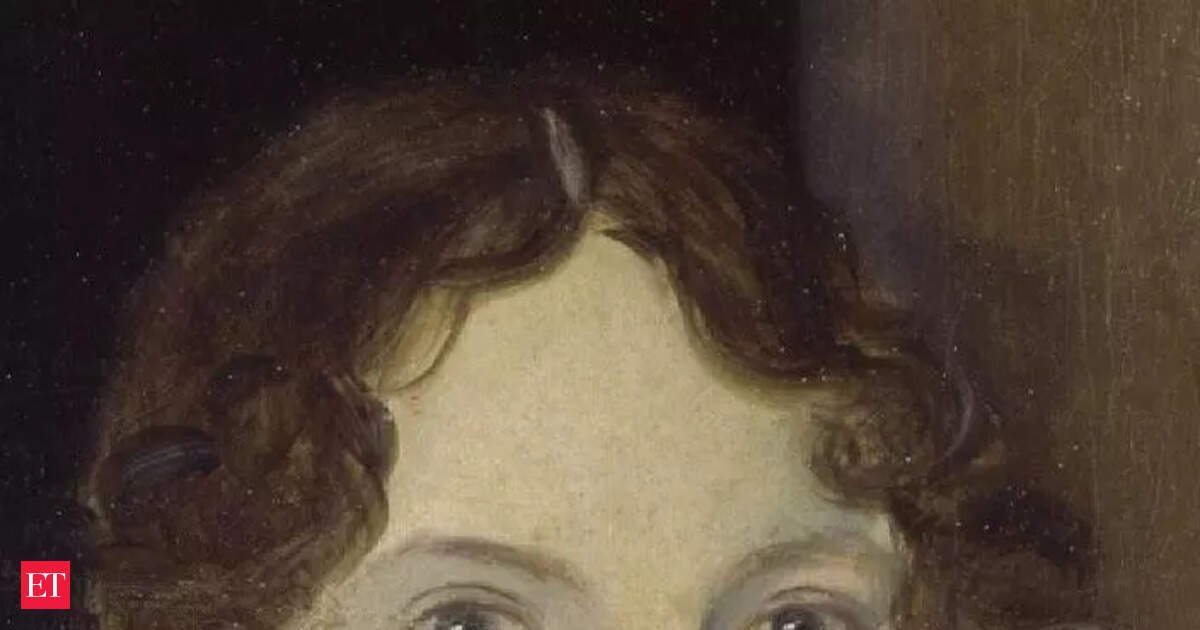

A Quote of the Day becomes powerful when it transcends greeting-card sentiment and reaches something deeper. On a day dedicated to love, this line reminds us that true intimacy is not merely affection but recognition — the sense that another person mirrors something essential within us. Brontë’s words endure because they capture love not as softness alone, but as shared essence, fierce and unbreakable.
Quote of the Day Today February 14

The Quote of the Day today by Emily Brontë is:
“Whatever our souls are made of, his and mine are the same.”
These words come from Wuthering Heights (1847), the only novel written by Emily Brontë, a work that would later be regarded as one of the finest novels in the English language and a masterful example of Gothic fiction.
Early Life in Yorkshire
Emily Brontë was born on July 30, 1818, in Thornton, Yorkshire, England, and died on December 19, 1848, in Haworth, Yorkshire, at the age of 30. In full, she was Emily Jane Brontë. She was an English novelist and poet who produced but one novel, Wuthering Heights, as per information sourced from Britannica.
Her father, Patrick Brontë (1777–1861), was an Irish-born Anglican clergyman who served in several Yorkshire curacies before becoming rector of Haworth in 1820, a position he held for the rest of his life. After the death of their mother, Maria Branwell Brontë, in 1821, Emily and her siblings were largely left to themselves in the bleak moorland rectory.
With her younger sister Anne, Emily invented the imaginary kingdom of Gondal, for which they wrote prose and poetry. Though much of the prose is now lost, the creative intensity of that private world foreshadowed the imaginative force that would later define her writing.
Emily’s formal education was limited. She spent a brief period at the Clergy Daughters’ School at Cowan Bridge in Lancashire, and later accompanied her sister Charlotte to Miss Wooler’s school at Roe Head, though homesickness cut her stay short. In 1842, she and Charlotte travelled to Brussels to study languages and school management at the Pension Héger. When their aunt Elizabeth Branwell died later that year, Emily returned permanently to Haworth, as per information sourced from Britannica.
Poetic Genius and Wuthering Heights
In 1845, Charlotte discovered that Emily had been writing poetry. This led to the publication in 1846 of Poems by Currer, Ellis and Acton Bell, a joint volume by the three sisters, who adopted masculine pseudonyms to avoid gender prejudice. Emily published under the name Ellis Bell. Of the 21 poems she contributed, later criticism has widely acknowledged that her verse alone revealed true poetic genius. Yet the volume sold only two copies.
By 1847, Emily’s novel Wuthering Heights had been accepted for publication. When it appeared in December of that year, critics were hostile. They described it as savage, animal-like and clumsy in construction. Its somber power and elements of brutality offended 19th-century sensibilities. Only later would it be recognized as a work of extraordinary imagination and intensity, as per information sourced from Britannica.
The novel recounts, through layered and retrospective narration, the destructive and obsessive bond between Heathcliff and Cathy Earnshaw in a remote Yorkshire setting at the end of the 18th century. Its dramatic and poetic presentation, unusual structure and absence of overt authorial commentary set it apart from other novels of its time.
Soon after its publication, Emily’s health deteriorated rapidly. Suffering from tuberculosis, she died in December 1848.
Meaning of the Quote of the Day
“Whatever our souls are made of, his and mine arethe same” speaks to a love that defies circumstance, morality and even destruction. In Wuthering Heights, the line expresses Cathy’s belief that her bond with Heathcliff is not dependent on social approval or worldly compatibility. It is rooted in something more fundamental.
On Valentine’s Day, the quote takes on renewed resonance. It suggests that love, at its deepest, is not about surface harmony or convenience. It is about shared substance — an alignment of spirit so profound that separation feels impossible. Brontë does not present love as gentle or safe. Instead, it is passionate, consuming and indivisible.
The line also reflects the broader character of Brontë’s writing. She constructs her narrative around profound and primitive energies of love and hate, allowing them to unfold logically and economically without decorative excess. The emotional force of the novel comes not from elaborate description but from the raw intensity of its characters.
In that sense, the quote captures both the romantic and the tragic dimensions of love. It is a declaration of unity, yet within the novel it also foreshadows suffering. Love, for Brontë, is powerful enough to transcend death, but not powerful enough to erase pain.
As today’s Quote of the Day, her words remind us that the most enduring love stories are not always the most comfortable. They are the ones that insist on unity of spirit, the belief that two souls, however flawed, recognise themselves in each other. On Valentine’s Day, that idea continues to echo across generations, as powerful and untamed as the Yorkshire moors that shaped Emily Brontë’s imagination.