
Getting your audio player ready…
What started as a routine elevator shaft installation in a Barcelona hotel basement has turned into one of the most significant Roman archaeology discoveries in Spain in decades. Excavations beneath the Gran Hotel Barcino in the city’s Gothic Quarter have uncovered a monumental stone pavement dating to the founding years of the Roman colony of Barcino – and the find has forced scholars to tear up nearly everything they thought they knew about the layout of ancient Barcelona. The forum, the beating civic heart of Roman urban life, was not where anyone expected it to be.
The discovery was announced in late February 2026 by the Barcelona Archaeology Service (ICUB) and has been hailed by city officials and archaeologists alike as a find of extraordinary national and international importance. Both the Catalan government and Barcelona City Council have already confirmed they will update museum displays across the city to reflect the new understanding of Roman Barcino’s urban plan.
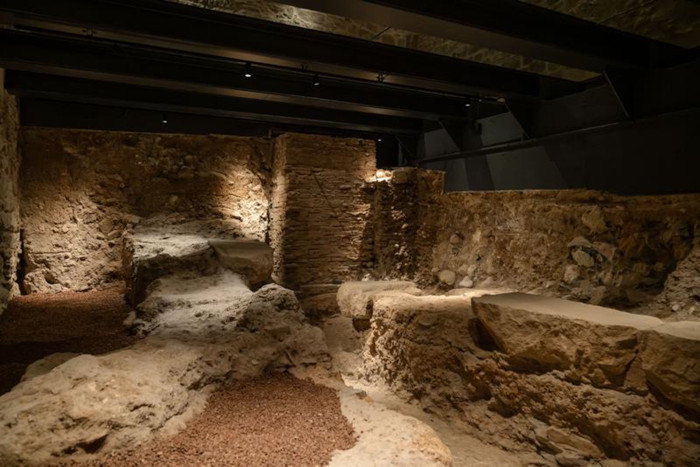
Roman Forum remains found in the archaeological excavation at the Gran Hotel Barcino. (ICUB)
A Hotel Elevator Shaft Opens a 2,000-Year-Old Door
The archaeological intervention began in June 2023 when workers at the Gran Hotel Barcino on Carrer d’Hèrcules 3, inside the historic Casa Requesens, a 14th-to-15th-century Gothic building, started digging a small hole for a new elevator shaft. The initial excavation covered just six square meters, and a routine preventive archaeological inspection was ordered as a formality. At a depth of approximately 2.5 meters, everything changed. Beneath the medieval and modern layers, workers struck a set of enormous, perfectly aligned stone slabs that clearly belonged to a far older world.
Recognizing the significance of what lay beneath, the hotel’s owners, the Gargallo Hotels chain, took the remarkable step of expanding the excavation area to 80 square meters and financing the entire two-year archaeological project themselves. The intervention, directed by Jordi Amorós of AGER Arqueologia and supervised by the Barcelona Archaeology Service and the Generalitat de Catalunya’s Territorial Cultural Services, ultimately ran from June 2023 to July 2025. What emerged from the earth was the first physical evidence of the actual floor of ancient Barcino’s forum – the central public plaza of the Roman colony founded by Emperor Augustus between 15 and 10 BC.

Photogrammetry of the Roman Forum pavement. (Global Geomatics)
Monumental Slabs and a Redrawn Map of Roman Barcelona
At the heart of the find lies a pavement of massive Montjuïc stone slabs covering approximately 42 square meters. The individual blocks are enormous by any standard – some measuring up to 149 centimeters long and 118 centimeters wide, with thicknesses ranging from 18 to 35 centimeters. The variation in thickness was deliberate: Roman builders used it to compensate for the uneven natural bedrock beneath the site, ensuring a perfectly level and durable surface. No pavement of this scale or quality had previously been found anywhere in Roman Barcelona.
The slabs are arranged in rows running northwest to southeast – a direction that is parallel to the decumanus maximus, the main east-west axis of the Roman city’s street grid, and perpendicular to the cardo maximus, the north-south axis. This seemingly technical detail carries enormous historical weight. For decades, scholars had believed that Barcino’s forum was aligned with the cardo, placing it in the area around the modern Palau de la Generalitat and Plaça Sant Jaume. The new pavement tells a completely different story.
“For years, we thought the Roman forum ran through the area of the Palau de la Generalitat,” said Xavier Maese of the Barcelona Archaeology Service. “Now we see that it turns 90 degrees from being parallel to the sea to being perpendicular,” quotes Catalan News.
The implication is striking: the forum of ancient Barcino was oriented along the east-west axis, running from the sea toward the mountains, not as historians had long assumed. “This is a unique find in Barcelona, both for its age and its function,” Maese added.

Roman well in the courtyard. (Jordi Amorós/Ager Archaeology)
Water, Marble, and the Grandeur of a Roman Colony
The excavation revealed far more than paving stones. Adjacent to the main pavement, archaeologists uncovered a substantial structure of Roman concrete along with two square wells, each more than 2.6 meters deep – a measurement equivalent to nine Roman feet, suggesting they were designed according to standard Roman engineering conventions. The two wells are connected by a siphon, a hydraulic mechanism that allowed water to flow between reservoirs by exploiting pressure differences and gravity. In a Roman civic context, such infrastructure almost certainly served an ornamental fountain or a water feature within the forum itself, underscoring the grandeur with which the colony’s founders intended to announce their presence, explains La Brujula Verde.
The site also yielded over 150 fragments of imported marble, sourced from quarries across the Mediterranean world: Carrara in Italy, mainland Greece, the Aegean islands, Anatolia, and Egypt. Their presence confirms that the forum area was once richly decorated with expensive architectural cladding — a statement of wealth and imperial ambition entirely in keeping with the colony’s full name, Iulia Augusta Faventia Paterna Barcino, which honored the Emperor Augustus himself. Until this discovery, the only architectural element that could be linked with certainty to the forum was the four surviving columns and podium of the Temple of Augustus, still visible today at number 10 Carrer del Paradís.
The excavation also documented the long decline of the forum. Ceramic evidence from within the wells dates their abandonment to the mid-6th century AD, while the spoliation of the pavement’s northeastern end — where slabs were removed and the voids filled with later ceramic materials — points to the forum losing its civic function at the beginning of the 5th century AD. This pattern of material reuse is consistent with the broader crisis of the late Roman Empire and the arrival of the Visigoths in Catalonia. Later layers at the site reveal domestic structures from Late Antiquity, medieval modifications, and even a grain storage silo from the Gothic period — a compressed timeline of 1,500 years of continuous human occupation visible in a single hotel basement.

The later, Medieval silo also uncovered at the same site. (Jordi Amorós/Ager Archaeology)
A Private Discovery for the Public Good
Perhaps as remarkable as the discovery itself is the way it has been handled. The entire excavation was financed privately by the Gargallo Hotels chain, with no public funding. Barcelona’s Culture Councilor Xavier Marcé praised what he described as a rare and exemplary alignment between private development and heritage preservation. Rather than proceeding with the original construction plan, the hotel adapted its renovation project around the remains, commissioning 70 micropiles to stabilize the Gothic-era building above while the excavation proceeded below.
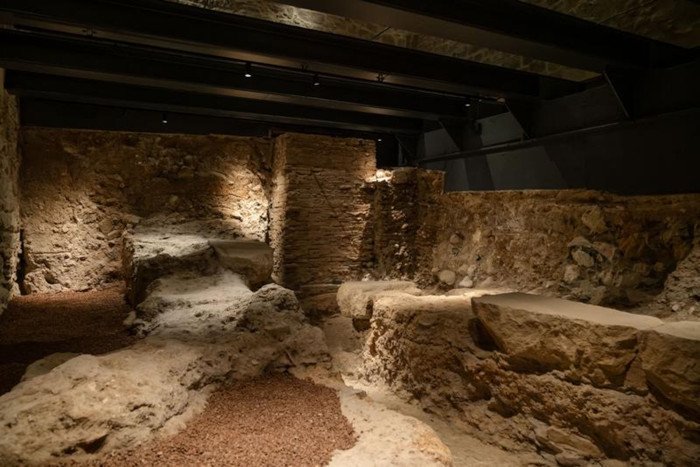
The Roman pavement and associated structures have now been stabilized and integrated into a museum space within the hotel’s underground level. Visitors entering the Casa Requesens will be able to look down through the layers of time — from the 1st-century AD forum pavement, through Late Antique domestic structures, to a medieval silo — all within a single illuminated space. While the site will primarily be accessible to hotel guests, periodic guided tours will be organized in coordination with Barcelona City Council, offering the public a chance to stand, quite literally, on the founding floor of their city.
The discovery adds a powerful new chapter to the story of Roman Hispania and underscores just how much of the ancient world remains buried beneath modern cities. For Barcelona, a metropolis that has long worn its Roman origins lightly — a few columns here, a stretch of wall there — the forum pavement is a reminder that the city’s deepest history is still very much alive underfoot.
Top image: The monumental Roman forum pavement discovered beneath the Gran Hotel Barcino in Barcelona’s Gothic Quarter, dating to between 15 and 10 BC. Source: Jordi Amorós / AGER Arqueologia
By Gary Manners
References
ACN / Agència Catalana de Notícies. (2026). 2,000-year-old Roman forum unearthed beneath Barcelona hotel. Available at: https://www.catalannews.com/society-science/item/2000-year-old-roman-forum-unearthed-beneath-barcelona-hotel
Ajuntament Barcelona, 2026. Discovery of the Roman forum of Barcino during the expansion works of the Gran Hotel Barcino in Carrer d’Hércules, 3. Available at: Discovery of the Roman forum of Barcino during the extension works of the Gran Hotel Barcino in Carrer d’Hércules, 3 – Barcelona Archaeology Service
Altuntaş, L. (2026 ). Monumental Roman Forum Discovered Beneath Barcelona Hotel Forces 90-Degree Rewrite of Ancient City Barcino. Available at: https://arkeonews.net/monumental-roman-forum-discovered-beneath-barcelona-hotel-forces-90-degree-rewrite-of-ancient-city-barcino/
Barcelona City Council. (2026 ). Rethink to the urban planning of Roman Barcelona. Available at: https://www.barcelona.cat/infobarcelona/en/forum-roma-2_1605200.html
Carvajal, G. (2026 ). The Roman Forum of Barcelona Discovered During Hotel Expansion Works. Available at: https://www.labrujulaverde.com/en/2026/03/the-roman-forum-of-barcelona-discovered-during-hotel-expansion-works/