
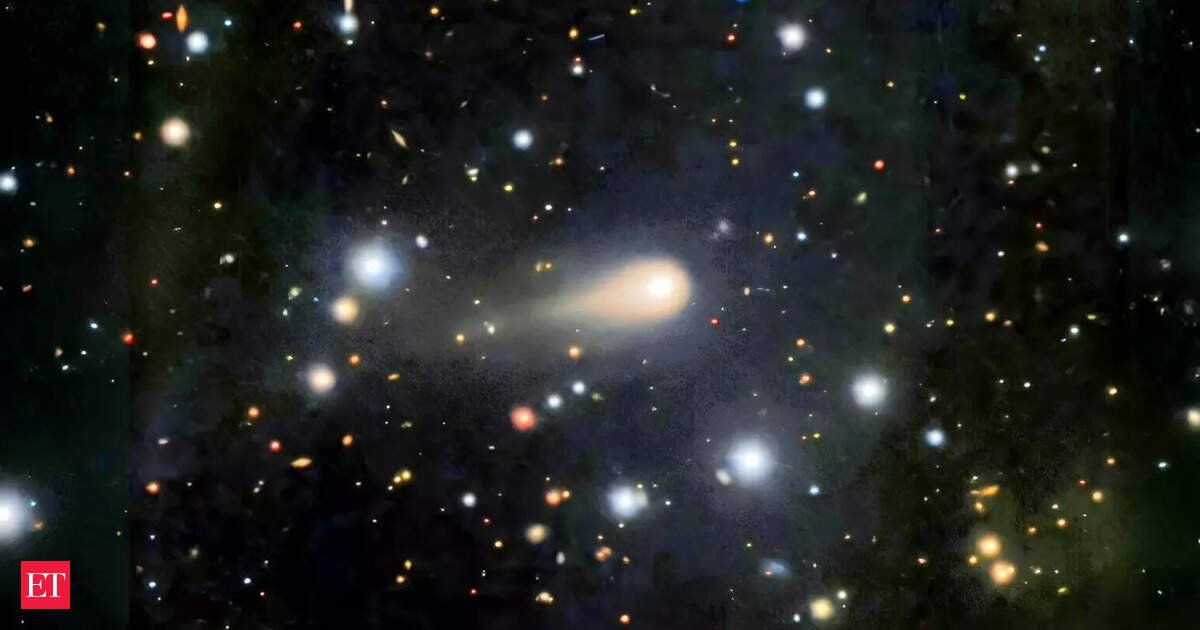

3I/ATLAS shows signs of alien engine and non-gravitational acceleration
3I/ATLAS shows signs of alien engine and non-gravitational acceleration, according to Harvard astrophysicist Avi Loeb. The Manhattan-sized interstellar object accelerated and appeared bluer than the Sun as it passed our local star. Loeb said the change in color and acceleration could suggest a propulsion system or artificial engine.
NASA recorded non-gravitational acceleration in the object this week. The acceleration indicated a major outgassing event, which is expected from a comet. Such outgassing would cause loss of mass and produce a visible debris plume in the coming months.
However, Loeb suggested that the same acceleration could also result from a technological source. In his Medium post, he wrote, “Alternatively, the non-gravitational acceleration might be the technological signature of an internal engine.”
He added that the bright blue hue might be caused by a hot engine or artificial light source, but also noted that it could be natural.
3I/ATLAS interstellar object observations and data from solar spacecraft
Earth’s telescopes could not directly observe 3I/ATLAS when it came within 172 million miles of the Sun, as Earth was on the opposite side. However, spacecraft orbiting the Sun ahead of Earth captured measurements showing rapid brightening.

The US Naval Research Laboratory reported that the supposed comet appeared distinctly bluer than the Sun. Earlier observations had shown it as red, later turning green. Loeb said the new color pattern was surprising and indicated unusual properties. 3I/ATLAS will make its closest pass to Earth on December 19, 2025, at around 167 million miles. This event will allow scientists to determine if it is a comet or an artificial craft. Loeb said that if no gas cloud is detected around 3I/ATLAS in December, it may indicate propulsion activity.
NASA’s position on 3I/ATLAS and public reaction
Loeb criticized NASA for withholding images taken by the Mars Reconnaissance Orbiter’s HiRISE camera during its close pass near Mars in early October. Sources suggested that the images will not be released until the government reopens.
NASA’s Acting Administrator Sean Duffy responded to public questions, saying that 3I/ATLAS is the third interstellar comet to enter the solar system. He denied any claims of extraterrestrial technology or danger to Earth. “No aliens. No threat to life here on Earth,” Duffy wrote on X.
Harvard astrophysicist’s continued research on interstellar objects
Professor Avi Loeb, who has long studied extraterrestrial signatures, said 3I/ATLAS will pass closest to Earth before Christmas. Between November 27, 2025, and January 27, 2026, it will be monitored by the International Asteroid Warning Network (IAWN).
If no massive gas cloud forms, Loeb said the observed acceleration could be a sign of a propulsion system. He compared this to the earlier interstellar object 1I/‘Oumuamua, which also showed non-gravitational acceleration without visible gas or dust.
Loeb explained that comet experts described ‘Oumuamua as a “dark comet,” meaning a comet without a visible tail. He argued that an object with a propulsion system could show similar behavior.
He wrote that scientific truth depends on data, not popularity, and urged continued study of anomalies like 3I/ATLAS.
Rapid brightening of 3I/ATLAS and scientific explanations
Scientists recently observed that 3I/ATLAS brightened faster than expected as it neared the Sun. Researchers Karl Battams and Qicheng Zhang reported that its brightening rate exceeded that of most Oort Cloud comets. The cause remains unclear.
Observations were made by several space-based missions, including SOHO, GOES-19, and NASA’s twin STEREO spacecraft. Ground-based telescopes will resume observations in mid- to late-November 2025, after it moves out of the Sun’s glare.
Battams and Zhang suggested that the brightening could be due to its velocity or unique composition. If its chemical makeup differs from Oort Cloud comets, it might indicate that it originated in a planetary system with a different chemical history.
The researchers noted that carbon dioxide sublimation appeared to dominate the comet’s activity even when it was three times farther from the Sun than Earth. This could mean cooling effects delayed water-ice sublimation and changed the thermal behavior.
Scientists say that 3I/ATLAS remains one of the few known interstellar visitors, offering rare insight into the makeup of distant planetary systems. Its unusual brightness and acceleration continue to raise questions about whether its behavior is natural or artificial.
FAQs
Q1: What makes 3I/ATLAS’s non-gravitational acceleration important?
It could reveal whether the interstellar object is a natural comet or an artificial craft, depending on whether it shows signs of propulsion or outgassing.
Q2: When will scientists observe 3I/ATLAS again?
The comet will be most observable between November 27, 2025, and January 27, 2026, with its closest approach to Earth on December 19, 2025.